Saturday, November 2, 2013

Reflections Of A Road Trip

On the road again -
Just can't wait to get on the road again.

            I don’t think I can fully endorse the sentiments that Willie Nelson expressed in his hit single, and a recent three week road trip that covered 20,000 km of air travel and a few more by car, has me really pondering what he was thinking! The reality is, however, there are aspects of this lifestyle I really love. They are very simply defined by the people I come in contact with. I feel truly blessed to be in the company, regularly and frequently, of quality, compassionate educators who are committed to making a difference for kids. As I reflect on this recent sojourn, that’s what keeps coming back to me.

            The trip began with a day in Los Banos, CA where I had the privilege of joining school-based administrators and district leaders on walkthroughs in a number of their schools. We were peeking in on classes to see how some of their newly designed RCD units were rolling out. There were many positive moments and mentioning one is arbitrary on my part but it was great to see how Corey led his algebra class through a lesson on Pythagorean theory and rates by engaging his students in a real world experience of being on the beach and wanting to get the shortest distance to the taco truck. Excellent kid talk that has them process math concepts while storing away the knowledge gained for a future time when they would be on the beach with a friend and know how they could get their tacos first (and maybe free depending on a friendly wager with an unsuspecting friend who wasn’t in their algebra class!).

            I followed that up with a day in Fontana where I have the good fortune of working with teachers who are using the RCD process to create new units of instruction in ELA. What’s inspiring about the work there is the collaborative nature of the group. They don’t shy away from challenges and engage in great collegial dialogue focused on making the highest quality learning experiences for their students. They do this while also placing a high premium on having fun and I benefit from their wisdom whenever we meet.

            From there, it was off to Woodridge, IL where I continued the ongoing RCD work with teachers as we revisited and refined the work already created. They’ve recognized that creating quality is not a finite process. Assistant Superintendent Greg Wolcott leads by example and is at all of the training sessions and has become as expert in the work as anyone I’ve encountered. That’s modeling the expectations and emphasizing the definition of team.

I did manage to squeeze in three days of rest so my wife and I could visit Chicago and I could run the marathon. The time went by quickly (although my race pace is slowing for some reason!).

I went back out to Woodridge for a two-day workshop on my 7 Keys book with a number of educators I was familiar with from the RCD work plus many others from neighboring districts. The group numbered over 100 and it was awesome to see how they processed the work and contextualized what I, and my co-authors (Charlie Coleman and Chris Weber), had put in print. I look forward to seeing the work these folks create when they get back to their school sites and do further planning with their colleagues.

From Chicago it was off to Toronto where I had the honor of being part of the inaugural Hulley Center event. A small but enthusiastic crowd embraced the sessions offered by this team:
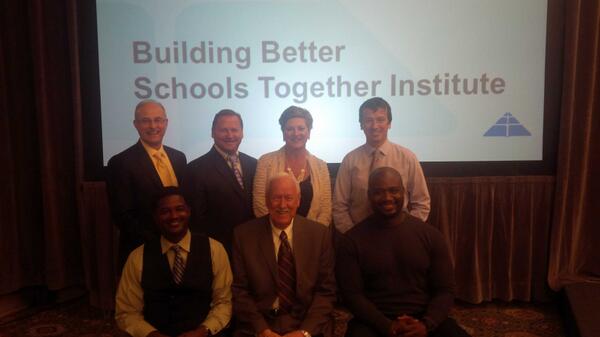
 

My tweet of the conference was a comment shared by Ken Williams:

Does that kid believe you believe in him? @unfoldthesoul #bbsti

There will be many great conversations occurring in schools as a result of this event. I can’t help but feel inspired every time I’m in the company of Wayne Hulley. He has set the gold standard for educators in Canada and reminds me of what’s possible when you build your work on the foundation of strong relationships.

            Being a Grandpa is one of the coolest things. Liam’s first birthday was too important an event to miss so I caught the flight from Toronto to Vancouver so I could enjoy the festivities. After the celebration, it was back east through Toronto to the Assessment Now conference in Atlanta.

            I enjoyed the opportunity to present four breakout sessions and to keynote alongside Marzano, Heflebower, Kanold, Fisher, and Guskey. The participants came from all across the United States and also had a strong Francophone contingent from the Ottawa region as well as a group of educators from Singapore. Some of the comments that generated further discussion, both at the conference and on Twitter, included:

Tom Hierck made the point that we have to meet people who resist change where they are.  Put the research on assessment in front of them and have conversations shift from default practices to practices that use the research about what's best for students.
            
We need to change. WHY? Because we R leaving 25% of stds behind in school..stds who don't graduate. #asmtNOW @thierck


                        TeachLearn68 ‏@TeachLearn68
As educators we have a greater impact than we know. Our impact lasts in student's hearts longer than the stuff we teach. @thierck   #AsmtNOW

                        @thierckTime is precious- spend it doing things that matter such as feedback & formative assessment #AsmtNow

                        need to push the conversation on assessment to focus on student learning. #asmtNOW Use our knowledge of teaching & learning.

You know your kids better than anyone else. Context matters.                                           Take what you learn & make it work for & in your community. ‪#AsmtNOW‬‬‬   

Tuesday, October 1, 2013

It Would Be So Easy If...

I’m writing this aboard another plane heading to another spot away from home. As much as I am not enamored with time in planes, airports, and hotel rooms, I consider myself fortunate to have the opportunity to work with, and learn from, so many talented and gifted educators. That I get invited to your workplaces, to your conversations, and to your challenges is a real honor.
Just as I think I did some of my best teaching with my most reluctant learners, I find that working with colleagues as they deal with their reluctant learners is the most satisfying. The dynamic has taken on greater importance as the options available to students who don’t experience success are getting slimmer and slimmer. Recent statistics indicate that a high school dropout is not eligible for 90% of the jobs in today’s workforce. When you couple that with the statistic that says the 50 largest cities in the United States had a graduation rate less than 60%, the challenges mount. Where once, rightly or wrongly, a person could leave school and find “living wage” work, those days are gone. In fact many currently employed folks struggle to get by on the wage they earn. High school plus further training is the minimum requirement for many jobs today.
What then, can we do for those kids who struggle - the kids who take up most of our time but seem to generate little success? These are the kids who periodically cross our minds when we think if I didn’t have them in my class, I could offer the others so much more and could yield better results. But here’s the catch – I just don’t know with any certainty which of those kids can be turned around because an adult invested in them. I do know this. Left unchecked and in the absence of any intervention by caring and compassionate adults, I can easily predict the options available to those kids. And so can you.
As Ron Edmonds noted in 1979,

“We can, whenever and wherever we choose, successfully teach all children whose schooling is of interest to us; we already know more than we need to do that; whether or not we do it must finally depend on how we feel about the fact that we haven't so far.”

Perhaps the sense of urgency wasn’t as profound in that time, and society on the whole was able to absorb low graduation rates with significant employment in manufacturing and agricultural sectors. This new urgency compels us to go further, do more, and push through our frustrations to minimize theirs and set them on a path to making a less bumpy transition to work or further training.
            I’m sure most readers are familiar with the story of the starfish on the beach. While we may not be able to save them all, start with one. It would be so easy if they were clearly labeled. In the absence of that begin with the first one you see whether it's starfish on the beach or kids in your school.


Tuesday, September 3, 2013

Choice Not Chance


Another school year has arrived and with it comes the optimism of a fresh start and the promise of many positive outcomes. While our energy reserves are high after a period of rest and recharge, the true measure of a successful school year resides in how we feel at the end of the school year. While I will always expect that educators “leave it all in the classroom”, I would not want to see anyone struggling to make it to the end of the year physically and mentally worn. There’s a big difference between positive and healthy tiredness and sheer exhaustion. How, then, do we ensure the former?

My guiding light in education over the bulk of my career has been Wayne Hulley. His emphasis on the power of relationship and the connections we make has always resonated with me. He advocates a model that he simply terms See-Do-Get.  In this cycle, how we see things - our belief systems, habits and culture – determines what we do. As a result of the things we do, we get the results we deserve. If you are after meaningful change you must first see things in a new way and then do something different that will lead to altered and hopefully, improved, results. I can’t help but see the world through this lens, which compels me to own the results I currently am getting.

A recent example occurred as I was in the midst of another road trip that took me through Phoenix. For those familiar with the area, you are likely aware of the dust storms that occasionally kick up. Called haboobs, they are a spectacle to behold. As we were coming in to land our pilot directed our attention to such a storm brewing in the distance. At the time we did not realize how quickly it would close in. Waiting in the terminal for my next flight, I sat by the window so I could watch the planes. I noticed the wind picking up and a brown cloud emerging. In a matter of two minutes the entire airport was enveloped in dust (http://www.csmonitor.com/Science/2013/0827/Phoenix-haboob-massive-dust-storm-rolls-into-Arizona). For many of us, this was a fascinating experience. Our “See” led us to take numerous pictures and video (our “Do”) and what we got was a sense of camaraderie as we remarked about the event unfolding and agreed to swap our best photos. However, not everyone had the same “See” and one passenger in particular became quite irate and was directing his frustration at the counter agent with an expectation that she could stop the storm, get the boarding process complete, and ensure departure as he “had places to be”. His “See” denied him a wonderful visual experience, an opportunity to connect with others, and a “Get” that was now more negative than anyone else’s. We all boarded our flight 90 minutes late but most were still talking about the unique event. His anger left him unable to take that in.

With the onset of the school year, what will your “See” be? Will you start the year off with carryover from last year about certain students? About kids in general? Will you long for the good old days and the kids you used to have? Will your focus be on all of the negative externals? Or will you look at every student as a success story waiting to be told? Will you enter the year with a focus to make this the best experience for your students and yourself? It’s not about being a Pollyanna or naïve to the challenges that being an educator entails. It is about exercising choice and not leaving things to chance. Your students this year deserve the best teacher you can be. You deserve the best year of your career. It all starts with what you choose to see.

As an aside, many of you who have taken advantage of Wayne Hulley’s wisdom over the years may be aware of a great opportunity to do just that at his inaugural Hulley Centre Conference in October (http://www.solution-tree.com/authors/wayne-hulley/building-better-schools-together-cfn153.html). Three days of very practical work with the focus of building better schools together. The work is truly derived from his passion to see every student reach their potential and every adult play a significant role in making that happen. I’ll be there and look forward to connecting with you then.

Monday, August 19, 2013

Value-Added Questions

            During my thirty years as an educator, I’ve seen many initiatives and advances in our profession. Some of the best of these are in the area of instructional design and delivery. Much of it gets expressed through professional development. We know more about the teaching and learning cycle than at any other time in education. This gets validated every time I talk with my youngest child who has just completed her teacher education program. I know that some of my best lessons and strategies would not work today, as they were heavy on teacher actions and activities and light on student learning. I don’t think I was alone in that design process. I’m also not suggesting it was an attempt to ignore the needs of my students. I’ll go so far as to say I thought I was a pretty effective teacher and I followed what other good teachers were doing.

            The shift described above combined with our increased knowledge about teaching and learning also gets validated every time I work with teachers today. Facilitating their work and witnessing their growth exposes me to different kinds of conversations than the ones I recall. The questions run deeper, reflect more layers of knowledge, and speak to the desire of teachers to keep pushing the boundaries in trying to uncover what works best for their students. They are asking value-added questions as opposed to cursory-knowledge questions. A recent opportunity to work with the four schools in Fort Leavenworth USD 201 highlighted this for me. I shared some thoughts on common formative assessments and their questions went beyond the nuts and bolts of CFAs and instead reflected their understanding of the approach and struggles with how to refine their efforts. Questions like these prompted great insights: 

How often should common assessments be done?

Should common assessments be used only for teachers of identical content or are there ways that teachers of similar content can use assessments to improve instruction?

When looking at the results of common assessments, what is the main goal behind that data analysis? 

How can the special areas support the common assessments?

            Ultimately, our work as educators gets refined and improved as we collaborate and share our best ideas and notions about what works to positively impact the learning of our students. Best practice does not always equate with the practice we are best at. Taking the time to learn more, ask more, and try more allows us to go deeper with the work and ask the kinds of questions that lead to better insights.


Monday, July 29, 2013

Maybe We Are Saving Dolphins


            One of the things I’ve always looked forward to about summers is the time to get caught up on some leisurely reading. It’s been a challenge this summer with more work than normal but I’ve managed to take advantage of time on planes and in airports. A recent book that has grabbed my attention (and spawned the title of this post) is “The Happiness Advantage” by Shawn Achor. I haven’t completed it but have been inspired by the first one hundred pages.
            Achor suggests that while there are some folks for whom positivity comes more naturally, he maintains that all can reap the numerous benefits of happiness. He states, “happiness is not just a mood – it’s a work ethic”. In the seven suggestions he provides to access the happiness advantage, three resonated with me in my current and previous work roles: commit conscious acts of kindness, infuse positivity into your surroundings, and exercise a signature strength.
            Committing conscious acts of kindness involves doing this deliberately and consciously, not recalling how your week went and recording the nice things you did. This doesn’t require grand gestures and Achor cites the research of Sonja Lyubomirsky indicating that the feeling of happiness last over many days for the initiator. I don’t often go through a drive-through for my coffee but when I do, I like to pay for the coffee of the person behind me in the line. I’ve never met the driver behind me but know it feels good to contemplate a positive moment that they might be experiencing.
            Infusing positivity into your surroundings speaks to the physical environment we create in our workspace. I know longer have an office where I can display personal mementoes that share some of who I am. I do, however, make a point of having pictures of my grandchildren on my computer screensaver that routinely get displayed in advance of my sessions and generate questions about them. They also never fail to bring a smile to my face and put me in the right frame of mind in advance of sharing with colleagues.
            Exercising a signature strength reminds me that everyone has a talent. During my recent work with teachers, I was reminded of the unique skills each person possesses as we were going through a dip in energy level on our fourth day of working together. Having teachers share their work with each other highlighted some individual strengths that went beyond curriculum design.  We’ve planned a social evening next week to further tap into aspects of individuals that don’t always get revealed in the midst of our work.
            As for the title of this post? Achor shares a story of a Fortune 500 senior level executive who introduced him and the importance of the happiness message by reminding employees that ultimately, it has to be about money and uttered the line, “We’re not saving the dolphins here.” Achor suggests that the message received was around the value of the work these employees were doing. Clearly it was not important stuff but centered on generating money. Let’s be clear here – the work you are doing as educators is significant. You are saving lives and impacting not only the lives of the students in front of you but also the lives they will lead as thriving community and family leaders. The beauty of our work lies not in our ability to predict the future but to create it. And in that realm we are doing more than saving dolphins, we're following a passion. Thanks for all you do to make the future brighter!


Monday, July 8, 2013

Is Your Focus On Kids Being Caught Or Kids Being Taught?


            A good portion of my time working with educators is spent on relationship building and creating a positive school culture. This work was really important to me during my time as a classroom teacher and building level administrator and took on even greater significance when I moved to a central office position where I could see a larger scale difference in the environments of schools and their relative success on most measures including staff and student satisfaction.
            Initially folks connected my work with discipline and dealing with challenging students. I remember quite clearly when I interviewed for the Vice-Principal job that discipline and behavior were the most oft-repeated words by the panel. After I landed the position former colleagues shared a concern about how dejected I would become after dealing with middle school behavior all day. My approach then is the same as the message I share now – it’s all in the perspective you bring and the motivation you have to build relationships.
            Let’s establish some basic premises. First, kids are going to make mistakes (and so are the adults). Second, consequences are a part of a positive learning environment (especially when they are connected to the behavior and are a natural result). Third, behavior can be changed through an instructional approach (just like we do with academics). Fourth, all kids can engage in positive relationships (although some may need more guidance from us). With that as the backdrop, the work becomes increasingly more positive, relationships get strengthened, and culture shifts as our words and actions align.
            When I work with school staffs today, we begin with identifying attributes or expectations for all (kids and adults) members of the school community. We use those in conjunction with key settings in the school to create a matrix of expectations that drive what we want to see throughout the school. When we don’t see them, we respond immediately, and with a positive re-statement of the desired expectations. Can you see the difference between this approach versus the approach that involves staff members creating an exhaustive list of “thou shalt nots” for kids? For those who think this may be another example of “going soft”, remember premise two above. Violations of the expectations may still result in a consequence – one that has a connection to the difference between what’s expected and what’s displayed. A continuum of consequences may include a suspension if there is not evidence of growth when we engage in teaching the expectations. It’s also important to remember the consequence is the consequence. It’s not that plus public humiliation in front of your peer group.
            When our focus is on kids being taught – both academically and behaviorally – and not solely on kids being caught, we shift the culture of the school to expecting the right things, modeling the right things, and acknowledging the right things. After all, isn’t that what schools are all about?